I brokered business transitions that ran on SBA financing, and here's the thing nobody says out loud about a 7(a) file: it is one of the most personally identifiable document packages assembled anywhere in finance. A mortgage file knows a lot about one borrower. An SBA acquisition file knows everything about the buyer, plenty about the seller, and a fair amount about both of their families — and then it gets emailed between more parties than almost any other loan type.
This is the guide for the people in that chain: lenders, loan brokers, packagers, and the buyers and sellers whose lives are in the file.
What's actually in a 7(a) package
- The personal financial statement. Every asset, every liability, every account — the borrower's entire financial identity on a handful of pages, SSN at the top.
- Three years of personal tax returns. The borrower's, and often a spouse's — SSNs on every page, dependents' names, home address, every income source.
- Government IDs. Driver's licenses and sometimes passports, photographed or scanned into the file.
- Bank statements. Months of them — account numbers, balances, and a transaction-level diary of the borrower's life.
- The seller's side. In an acquisition, the business's financials frequently interleave the seller's personal returns, and the purchase agreement carries both parties' signatures, addresses, and guarantee terms.
- Life insurance, leases, franchise agreements — each with its own layer of personal identifiers and account references.
Where it multiplies: the copy problem
A loan file's risk isn't its contents — it's its circulation. Watch the hops:
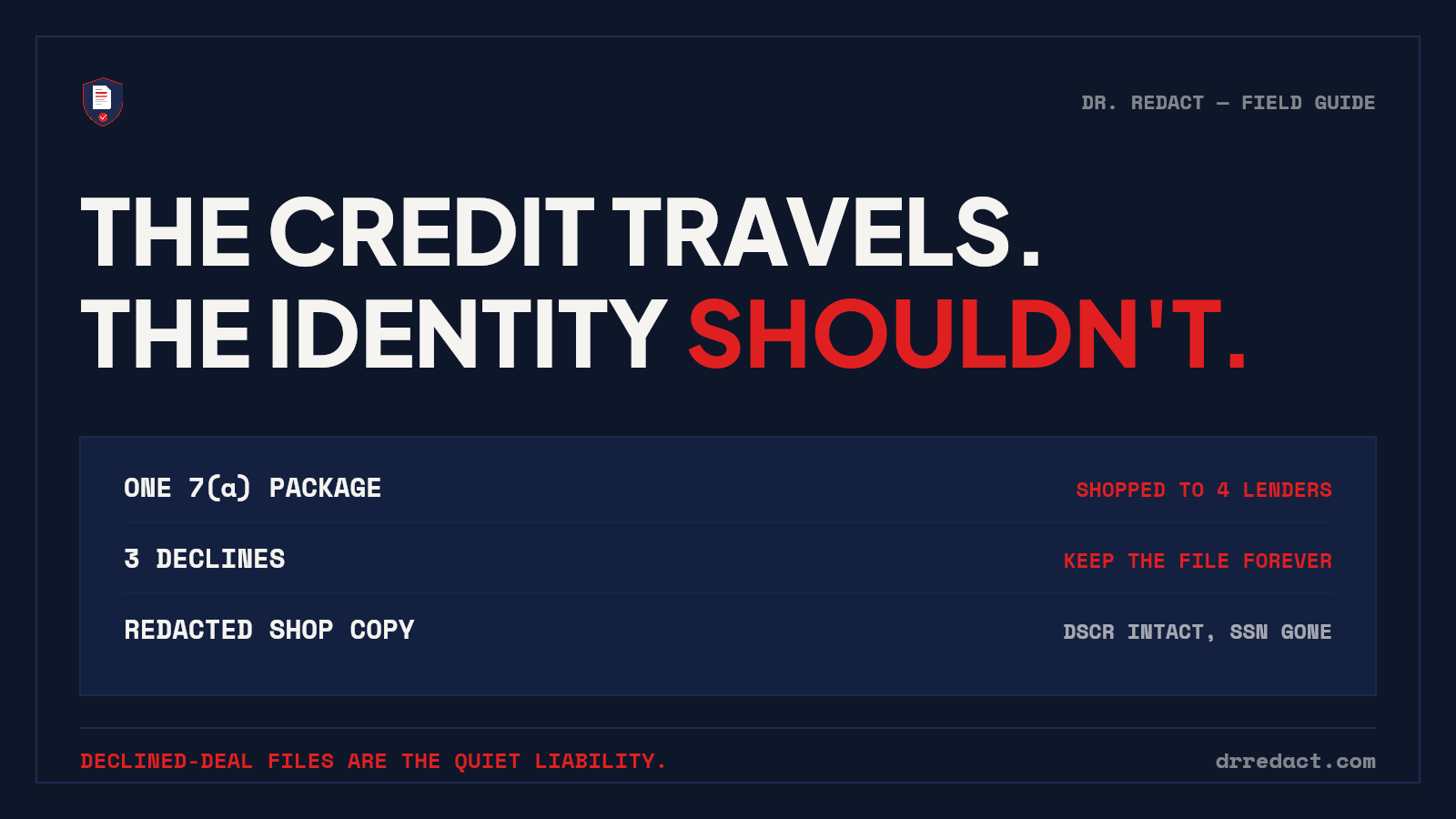
The shop. A broker takes one borrower's package to three or four lenders to find the best structure. That's the correct move for the borrower's deal — and it also means three or four complete copies of their financial identity now live in institutions that will decline the loan and keep the email forever. Declined-deal files are the industry's quietest liability: nobody services them, nobody audits them, and nobody deletes them.
The internal relay. Inside the lender, the file moves from BDO to underwriter to closer to servicing — often by email attachment, each forward another copy outside any retention system.
The secondary market. 7(a) guaranteed portions are sold and loan files change hands in due diligence. A file prepared for sale needs the credit story intact — and has no need to carry the borrower's SSN into yet another institution's storage.
The audit and the subpoena. SBA reviews, OIG requests, and litigation pull files into new hands years after closing, when nobody remembers what's in them.
Every one of those hops is legitimate. None of them requires the full identity payload the file was born with. That's the whole discipline: the credit travels; the identity shouldn't have to.
What stays visible
Underwriting and diligence run on numbers, not identifiers: cash flow and DSCR, collateral values, business revenue and margins, guarantee structures, use of proceeds, the terms. A reviewer evaluating a participation or a secondary purchase can price the credit perfectly from a file where the SSNs, account numbers, and ID photos are permanently gone. The skill — same as in every regulated document workflow — is show the credit, remove the person.
The regulatory floor, briefly
Lenders live under the GLBA Safeguards Rule for customer financial information, and state breach-notification laws in all 50 states cover the personal data in these files regardless of who's holding the copy. But honestly, the sharper motivator is commercial: borrowers are referred by accountants, attorneys, and brokers who hear about it when a client's tax returns end up somewhere they shouldn't. In a referral business, the file-handling is the reputation.
How this works with Dr. Redact
Dr. Redact was built for exactly this shape of document: dense, mixed-format, and full of identifiers in inconsistent places. Upload the package — scanned pages, phone photos of paper, handwriting included; OCR is automatic. The engine flags SSNs, account and routing numbers in the formats banks actually print, IDs, addresses, and signatures across 65+ categories. A human reviews and rules on every single detection — the tool proposes, your closer or packager decides. Approved items are burned out at the pixel level, the unredacted original is destroyed at processing, the output stays fully searchable for the underwriter on the other end, and plans from the Standard Pack up produce an audit certificate for the credit file.
Then run the verification habit on any tool's output, ours included: select all, copy, paste into a text editor, search for the SSN. If it's findable, it wasn't redacted. Full method guide: how to redact a PDF properly.
Quick answers
When in the process should redaction happen? At every hop where the recipient doesn't need identity to do their job: the multi-lender shop, the secondary-market package, the audit response. The originating lender's own credit file keeps what regulation requires; the copies are where minimization lives.
Will a redacted package slow underwriting? The opposite of what you'd expect: the output stays text-searchable, the financial story is untouched, and the audit certificate documents exactly what was withheld — which reads as process maturity, not obstruction.
What about declined deals? The cleanest answer is to send less identity in the first place — a shop package that never contained the SSNs leaves nothing radioactive in a declining lender's inbox.
Paper in the file? Photograph it with your phone directly on the site — no scanner, no app — and it runs through the same detection, review, and burn as any upload.
First pages are free at drredact.com, no card required — try it on a dead-deal file and see what's still sitting in your sent folder.