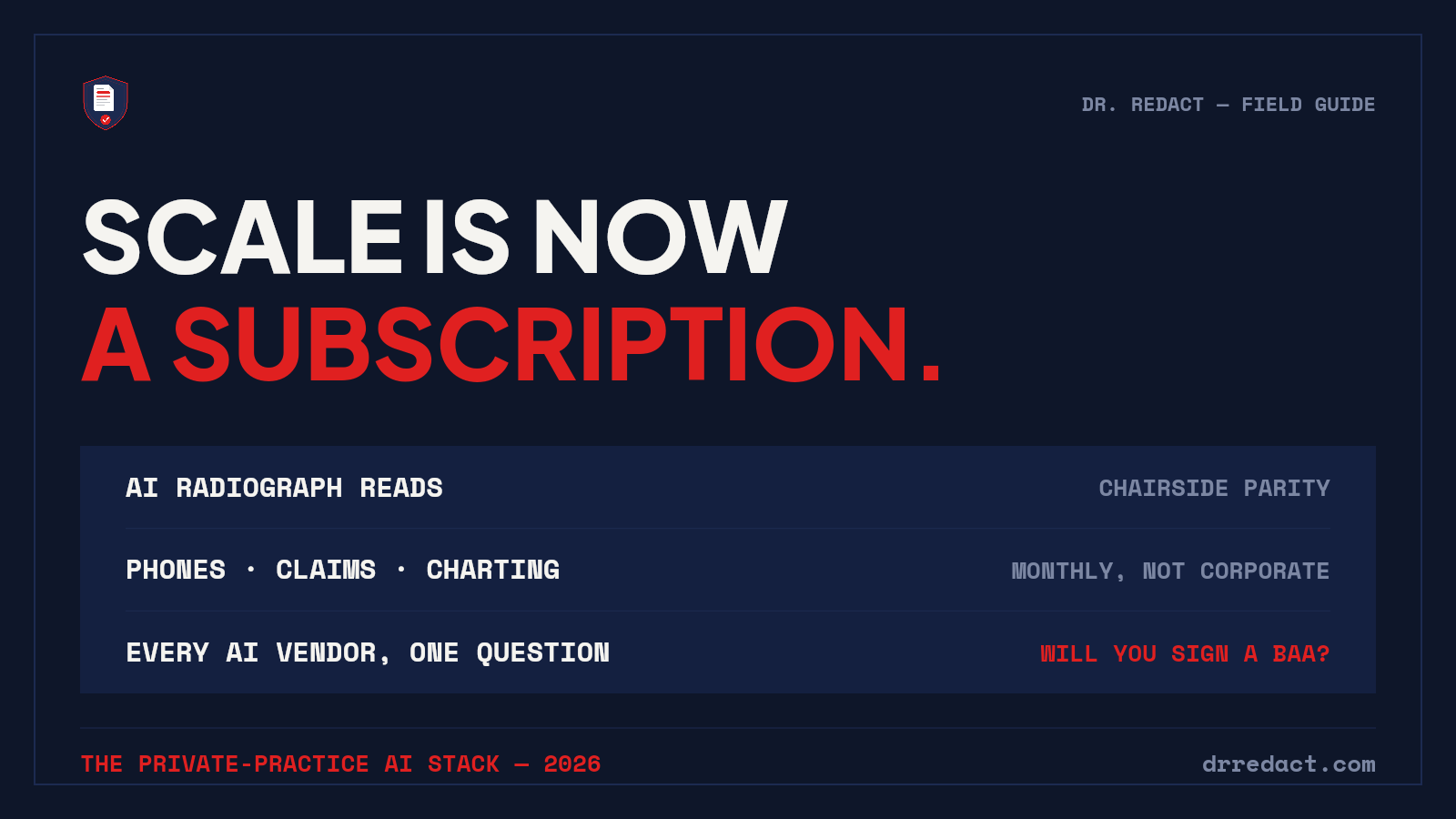
I spent almost 20 years consulting private practices on their practice management software, SOPs and technology — 16 at Patterson Dental and 3 at Burkhart Dental — and I watched the corporate wave arrive in real time. The pitch a DSO makes to a selling dentist has always been the same: we have scale you can't match. Centralized billing. A call center that answers every phone. A marketing department. A compliance officer.
For most of my career that was simply true. What's changed — fast — is that AI now sells scale by the month, to anyone. The call center, the billing follow-up, the second set of eyes on a radiograph, the compliance workflow: there is now a tool for each that a three-operatory practice can run without an IT department.
This is my honest map of that landscape. I built one of these tools, and I'll be clear about which one and what it does — but the point of this guide is the whole stack, because a private practice that adopts three or four of these keeps the thing corporate dentistry can't buy: the owner's name on the door.
First, the question that sorts every AI vendor
Before any feature demo, ask the vendor one question: "Will you sign a Business Associate Agreement?"
If the tool touches patient information — and in a dental office, almost everything does — HIPAA requires a BAA between your practice and the vendor. The answer sorts the market instantly:
- "Yes, it's part of onboarding" — a real healthcare vendor. Proceed to the demo.
- "What's a BAA?" — a general-purpose tool wearing a dental costume. Walk away, or use it only for work that contains no patient information.
- "It's available on our enterprise tier" — scale pricing in disguise. This is where DSOs used to have the advantage; insist on it at your size or move on.
Sixteen years of HIPAA training condensed to one sentence: the vendor's BAA answer tells you more than their feature list.
The stack, category by category
1. Radiograph analysis — the chairside second opinion. FDA-cleared AI that reads X-rays for caries, bone loss, and calculus is the most mature category in dental AI — Overjet, Pearl, and VideaHealth all hold clearances, and large DSOs have already rolled this out chairside. That's exactly why it matters for private practices: when the corporate office down the street shows patients an AI-annotated radiograph and you show a gray film and a "trust me," case acceptance tilts their way. This category is where matching the DSOs matters most, and it's available to a single location.
2. The front desk phone. AI phone agents now answer after-hours calls, book appointments into open slots, and answer the "do you take my insurance" call that used to go to voicemail and then to the practice across town. A DSO call center answers 100% of calls; a busy front desk answers what it can between check-ins. This is the gap AI closes most directly — evaluate any vendor on whether it writes into your practice management software or just takes messages.
3. Voice charting. Perio charting by voice — the assistant reads pocket depths aloud, the AI records them — turns a two-person job into a one-person job. In a practice where the hygiene schedule is the profit engine, that's real capacity, not a gadget.
4. Insurance and revenue cycle. Claims scrubbing, denial prediction, and automated follow-up on unpaid claims — the unglamorous work DSOs centralize into a billing department. AI-driven RCM tools now do the follow-up grind for a single location, and this is often the fastest payback in the stack: the money is already earned, it's just stuck.
5. Writing and admin — with a bright red line. General AI assistants (ChatGPT, Claude, and their peers) are genuinely useful for the writing a practice owner does at 9 PM: the patient-dismissal letter, the updated financial policy, the job posting, the tricky insurance appeal paragraph. Use them for all of it — but never paste patient information into a consumer AI chatbot. The free and standard consumer tiers of general-purpose chatbots don't come with a BAA, which makes pasting a patient's name, chart details, or an EOB into one a HIPAA disclosure to a vendor with no obligation to protect it. Draft with placeholders — "[PATIENT]" — and add the specifics after you paste the result back into your own systems. This single habit is the difference between AI as a superpower and AI as a reportable incident.
6. Records releases and redaction — the one I built. Every practice releases records: attorney requests, insurance audits, specialist referrals, and — when the day comes — practice-transition due diligence. The HIPAA risk in a release is rarely the requested record; it's the ride-alongs, like the other 39 patients on a day sheet or the extra claims on a batched EOB page. Dr. Redact is AI detection with human approval: upload the release set (or photograph paper charts with your phone), the engine flags patient identifiers across 65+ categories, the front desk approves or rejects every single item, and approved redactions are removed permanently — original destroyed, output still searchable, and on plans from the Standard Pack up, an audit certificate for the compliance binder. A BAA is available on every paid plan, executed electronically in minutes. I wrote a full front-office guide here: Redacting Dental Records: A Practical PHI Guide.
What corporate dentistry still does better — and what it can't do at all
Honesty cuts both ways. A DSO still negotiates better supply and lab pricing, still absorbs a bad month more easily, and still has a recruiting pipeline when your associate leaves. AI doesn't fix any of that.
But walk the list above and notice what happened: the call center, the billing department, the radiology consult, and the compliance workflow — the four pillars of the DSO scale pitch — are now monthly subscriptions. What's left as the corporate advantage is capital. What's left as yours is everything patients actually switch practices over: the doctor who remembers them, the hygienist they've seen for a decade, the front desk that knows their kid's name.
The practices that stay independent through this decade won't be the ones that avoided AI. They'll be the ones that adopted it deliberately — one category at a time, one BAA at a time — and spent the saved hours on the parts of dentistry no one has automated.
A 30-day starting plan
1. Week 1: Ask your current software vendors what AI features you're already paying for and not using. (Patterson, Henry Schein, and the PMS vendors have been adding them.)
2. Week 2: Pick your biggest leak — missed calls, unpaid claims, or case acceptance — and demo two tools in that one category. Ask the BAA question before the feature demo.
3. Week 3: Set the office AI policy in writing: which tools are approved, and the placeholder rule for consumer chatbots. One page. Everyone signs it.
4. Week 4: Run one real workflow end to end on the tool you chose, measure against last month, and decide with numbers.
Your first pages with Dr. Redact are free at drredact.com — use a sample or de-identified document on the trial (it isn't covered by a BAA), and when you're ready for real charts, the BAA is a five-minute click on any paid plan.